
3 Mistakes Riders Make Before a Big Show
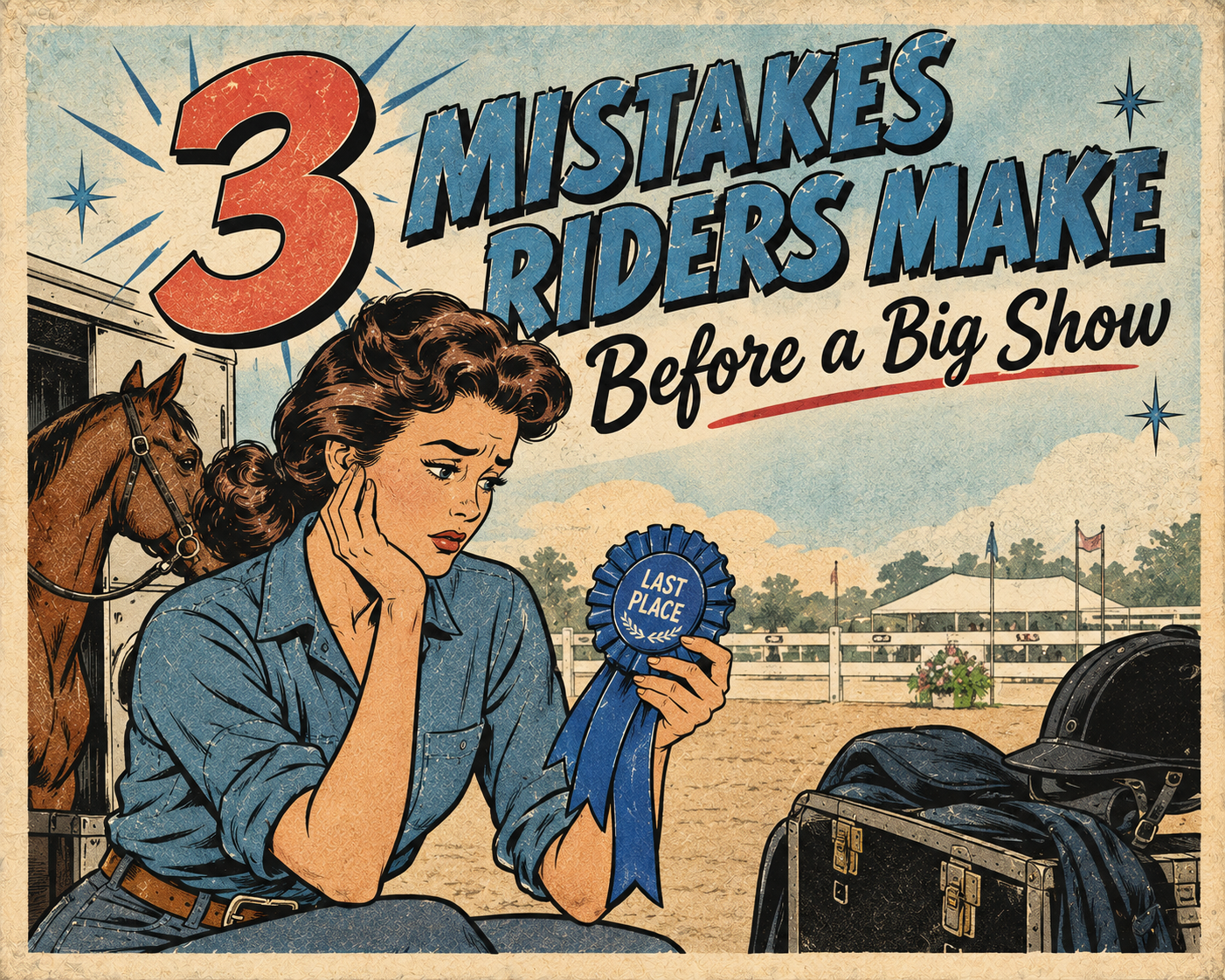
Big shows have a funny way of making perfectly sensible riders suddenly forget everything they know.
Suddenly, the goal you’ve been working toward for months becomes, “I HAVE TO WIN THIS.”
The training plan you’ve followed all year? Out the window.
And instead of celebrating the things that went beautifully, you’re sitting in the trailer replaying the one lead change that was approximately 4% less than perfect.
If this sounds familiar, consider this your pre-show reminder: the goal of showing isn’t to magically become a completely different rider when you walk through the gate. It’s to show off the hard work you’ve done at home.
Here are three mistakes I see riders make before and during a big show, and what I’d rather see you do instead.
1. Setting Outcome-Based Goals
“I want to win this class.”
“I want to get a Top 5.”
“I want to beat so-and-so.”
“I want a certain score.”
These goals are understandable. Of course you want to win. We all do.
The problem is that you have very little control over them.
You can ride the best pattern of your life and still not win. You can make a mistake and still place. You can have an incredible ride and have the judge see something differently than you did.
So instead of making your goal something that depends on everyone else in the arena, make it something you can actually control.
That’s where process-based goals come in.
Instead of:
“I want to win this class.”
Try:
“I want to feel prepared every time I step into the show pen.”
Or:
“I want to ride every transition with the same preparation I use at home.”
Or:
“I want to stay present and ride the horse underneath me instead of worrying about what everyone else is doing.”
Now you have something you can actually accomplish.
And here’s the best part: process goals don’t mean you have to stop being competitive. You can absolutely want the blue ribbon. You just don’t want the blue ribbon to be the only evidence you have that you had a successful show.
Your job is to control your preparation, your riding, your mindset and your response. The judge gets to control the rest.
2. Changing the Plan at the Horse Show
You know that little voice that shows up at a horse show and says:
“Hmm… maybe we should completely change what we’ve been doing.”
No.
Stop that thought right where it starts.
The horse show is not the time to invent a new training program.
If you’ve spent the last three months practicing your transitions, your turns, your lope overs, your body position and your showmanship crossovers, the goal at the horse show is to put those skills to work.
It is not to suddenly decide that your horse needs a completely different warm-up because you watched someone else doing something interesting.
It is not the time to ride around for 45 minutes trying to fix something that was fine yesterday.
And it is definitely not the time to decide that your entire training program is wrong because your first practice ride felt a little funky.
Your horse show should be the final exam, not the study session.
Of course, you should make adjustments when something genuinely needs attention. Good horsemanship means paying attention and responding to your horse.
But there is a big difference between making a thoughtful adjustment and panic-training.
The work happens at home.
The horse show is where you show off the work.
Trust the plan you made when you were calm, thinking clearly and had weeks of training data in front of you.
3. Focusing on What Went Wrong
This one might be the biggest show-day trap of all.
You finish your class and immediately start the post-mortem.
“I messed up my back up again.”
“My first transition was terrible.”
“I was too tense.”
“I missed that lead.”
“I should have done that differently.”
Meanwhile, your horse just gave you the best lope overs you’ve had all year.
But somehow, all you can think about is the back up.
Your brain really said, “Yes, but what about that one tiny mistake?”
Your brain is naturally going to notice mistakes. That’s useful when we are trying to improve. But if every post-show conversation becomes a list of everything that went wrong, you’re teaching yourself to associate showing with failure.
Instead, I want you to get in the habit of asking:
What went right?
Maybe your lope overs felt fantastic.
Maybe you stayed calm when your horse got distracted.
Maybe your transitions were more consistent than they were last month.
Maybe you finally felt like you were sitting in the middle of your horse instead of chasing the movement.
Maybe you walked into the pen feeling prepared.
Those things matter.
And yes, we should absolutely take notes on what needs work. That’s how we get better. But I want your post-show analysis to sound more like a coach reviewing game film and less like a prosecutor building a case against you.
Try this:
What am I proud of?
What did I learn?
What is one thing I want to improve before the next show?
That’s it.
You don’t need to relive every imperfect moment for three days.
A mistake is information. It is not a personality trait, a prediction of your next class or proof that you aren’t ready.
@crystadbrown A very sleepy 2026 APHA World Show recap 😴🤍 I’m so grateful for the incredible clients at @SWShowhorses . It was so much fun watching everyone grow throughout the show and seeing all of your hard work come together. I’m also incredibly thankful for the friends and followers who stopped to chat. It means so much that you trust me to be part of your journey. Every show seems to reveal a few recurring themes, and these are three I can’t stop thinking about after this one. What did you learn at your last show? Was there something that surprised you? I’d love to hear it in the comments. #aphaworldshow #equestrian #horsetrainer #horsegirl ♬ original sound - CrystaDBrown
Your Big Show Game Plan
So before you head to your next big show, remember:
Don’t obsess over the outcome. Focus on how you want to ride.
Don’t rewrite the training plan at the horse show. Trust the work you did at home.
Don’t let one mistake erase everything that went well.
The ribbon is the bonus.
The real win is walking out of the pen thinking, “Yep. That looked like the work we’ve been putting in.”
And when the show is over, your video can tell you even more. Instead of only replaying what went wrong, use your footage to figure out what worked, what needs attention, and what to take home to your next training session.
Need a second set of eyes? A Pattern Video Review gives you personalized feedback on your ride and a game plan for what to work on next.
Turn your show into your next training plan.
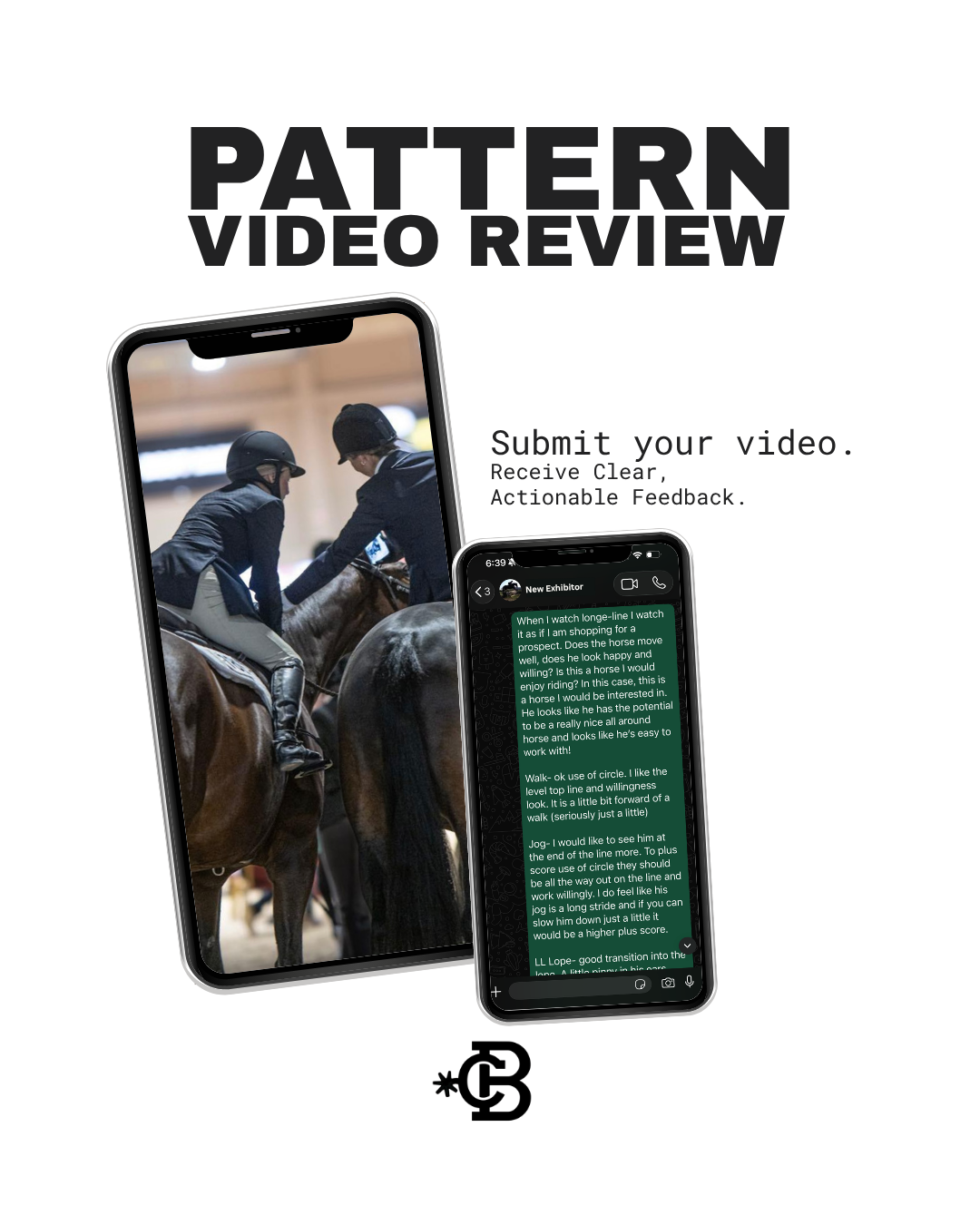
Personalized, Score-Focused Feedback on Your Pattern
For the riders wanting to know where they may be leaving points on the table!
Submit up to 2 minutes of your pattern ride (from a show or practice at home), and I will review it through the lens of a scorecard but with the tools of a horse trainer.
This review applies to patterns including:
Ranch Riding
Ranch Pleasure
Horsemanship
Equitation
Trail
Western Riding
English Versatility
Western Versatility
Showmanship
And similar pattern-based classes
All levels and divisions are welcome
What You’ll Receive
Direct feedback on where you may not be maximizing points.
The 3–5 changes that would make the biggest difference in your score
Notes on horse and rider correctness to the rulebook and overall presentation
Clear, prioritized adjustments you can apply immediately
Feedback is delivered via text or voice note
When relevant, I’ll attach links to:
YouTube examples of riders demonstrating the technique discussed
Podcast episodes or book recommendations to deepen your understanding
Educational resources that support the specific correction
How to Submit
Send up to 2 minutes of video via WhatsApp (We’ll email you contact info)
When possible, also include a copy or photo of the pattern
(This helps me evaluate accuracy, strategy, and execution more precisely.)
What This Is
A focused review of one pattern ride
Honest, professional feedback
Prioritized corrections (not a bunch of minor nitpicks)
Designed to improve your score efficiently
What This Is Not
Ongoing coaching
Unlimited follow-up messaging
A full training program
Emergency pre-show availability
If you're preparing for an upcoming show or trying to move up in placings, this gives you clarity on what actually matters.
Note Feedback will be received within 5 business days to allow for Crysta’s travel and show schedule but most are delivered within 48 hours.
