
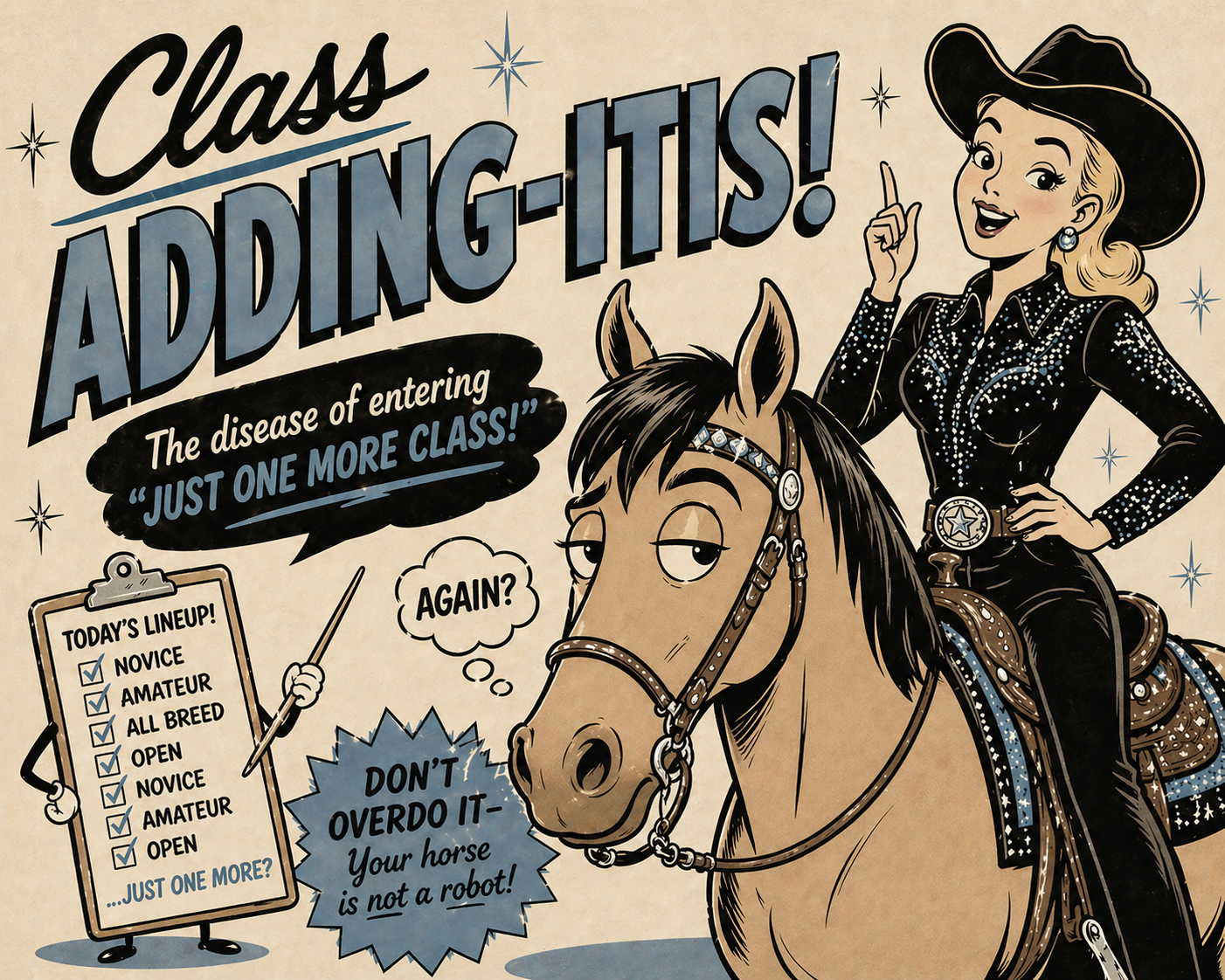
Class Adding-itis
The disease of entering “just one more class”
I have a question.
At what point does “taking advantage of a good day” turn into taking advantage of your horse?
Because if you’ve ever sat at a horse show and watched someone go in class after class after class, you’ve probably had the same quiet thought:
Is that really fair?
The “Let’s Fix It” Spiral
Something goes wrong in a class.
Maybe the lead change is late. Maybe the horse spooks. Maybe the pattern falls apart.
So what do we do?
We enter another class. And another. And maybe one more for good measure.
Because in our minds, we’re “fixing it.”
But here’s the uncomfortable truth.
If your horse wasn’t prepared to handle that situation the first time, repeating it in a higher-pressure environment, multiple times in a row, rarely improves the outcome.
It usually does the opposite.
Now the horse isn’t just unsure. They’re tired, mentally fried, and starting to associate the show pen with pressure, correction, and discomfort.
And that behavior you were trying to fix?
It often gets worse.
The “Why Not?” Marathon
Then there’s the other side.
The horse is going great. Everything feels easy. You’re winning, placing, or at least competitive.
So… why not enter:
The novice
The amateur
The open
And maybe the all breed just because you’re already here
On paper, it feels efficient. Smart. You already paid the haul, you're getting your money’s worth.
But step back for a second.
If you rode that same horse that many times at home, back-to-back, for multiple days in a row, would you call that good horsemanship?
Or would you call it overdoing it?
“If you rode that same horse that many times at home, back-to-back, for multiple days in a row, would you call that good horsemanship?”
The Part We Don’t Talk About Enough
Horses don’t just get tired in the obvious ways.
It’s not always big, dramatic lameness.
It’s the quieter things:
A back that starts to get sore
Muscles that don’t recover between days
A horse that feels a little flatter each go
Subtle resistance that builds over time
And then a few years down the line, we wonder why they don’t hold up.
Why they don’t stay as willing. As sound. As consistent.
We want long careers from our horses.
But long careers are built on how we manage them today, not how talented they are.
Schooling in the Show Pen… With a Plan
Let’s be clear.
There are absolutely times when a horse needs to go in the show pen and learn that it works the same as home.
That’s part of developing a show horse.
But if every show turns into multiple “schooling runs,” it’s worth asking a harder question.
Was the horse actually prepared before you got there?
Because the show pen should not be the place where your horse learns everything for the first time.
And if the arena consistently becomes a place where they feel pressure, correction, or exhaustion, they will start to dread it.
If you want a behavior to improve, you have to make the experience one the horse can succeed in.
Not just hoping for the best.
Think in Years, Not Weekends
This is where most people get it wrong. They make decisions based on the current show. The current class. The current weekend.
But the real question is this:
Are you building the horse you want 10 years from now?
Because every extra class, every tired run, every moment where the horse is pushed past a reasonable limit… it adds up.
You’re either building durability and confidence. Or you’re slowly chipping away at your horse’s goodwill.
So What’s the Smarter Play?
Be selective.
Not every class needs to be entered. Not every mistake needs to be fixed immediately in the pen. Not every good day needs to be maximized. Sometimes the best decision you can make is to stop while you’re ahead and just let each class be information to you. Let your individual runs help guide how you want to practice going forward. It’s okay to stop before things unravel. That’s not leaving something on the table, or letting your horse “win”.
That’s protecting the horse that’s going to carry you forward.
Let’s Be Honest About Your Plan
If you’re not sure how much is too much, or you’re finding yourself making these decisions in the moment at shows, that’s usually a sign you don’t have a clear plan going in.
And that’s something we can fix.
In a Competitive Roadmap Call, we can map out not just what your goals are, but how to show your horse in a way that actually supports those goals long-term.
Because it’s not just this horse show.
It’s about having a horse that’s still sound, willing, and competitive years from now.
You can book your call here and start showing with a plan instead of a guess.
Do you know where you want to go in the show pen but are not sure how to get there?
The Competitive Roadmap Call is a 30 to 45 minute strategic planning session designed to help you map a clear path from where you are now to where you want to be.
Whether you:
Have a green three year old and dream of the World Show
Want to move from local shows to breed level competition
Want to step up into a bigger training program but don’t know where to start
Feel stuck in your riding career
This call is where we build the plan.
What We Do on the Call
This is a focused strategy session where we:
Define your competitive goals clearly
Evaluate your current situation including horse, budget, training setup, and timeline
Identify the gaps between where you are and where you want to be
Map realistic steps to close that gap
Decide what makes the most sense next, whether that is lessons, partnering with a trainer, course work, training adjustments, or strategy at the show
You will leave with:
A clear competitive target
A structured plan
Confidence in your next move
How It Works
After purchase, you will receive an email with instructions to schedule your session.
Please block out 30 to 45 minutes for your call and come prepared with your goals and ideal equestrian dreams. No dream is too big.
At your scheduled time, Crysta will call you via FaceTime Audio or WhatsApp to avoid international calling fees.
You are welcome to record the call or take notes.
Everything discussed remains completely confidential between you and Crysta. This is a safe place to think big, ask hard questions, and speak openly without worrying about barn gossip.
Who This Call Is For
This call is ideal for riders who:
Are serious about improving
Want clear direction
Value honest, straightforward guidance
Are ready to stop wandering and start planning
If you are ready to move from hoping to having a clear competitive roadmap, this is where it starts.
